
Nusa Penida
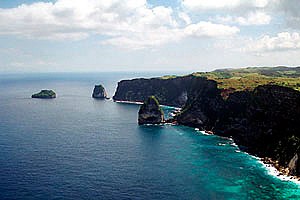
Nusa Penida is the largest of the 3 islands which are found across the Badung strait on the South of Bali. The Badung strait is known by geologists as the transition zone between Asia and Australasia.
The islands are part of the Klungkung district of Bali, and centuries ago Nusa Penida was used as a penal colony for unwanted and
criminal people from this district.
There is one Muslim village at Toyapakeh, but the majority of the island is Hindu.
According to Balinese believe the island is the legendary home of the demon Jero Gede Macaling, the inspiration of the Barong Landung dance, see Barong Dance.
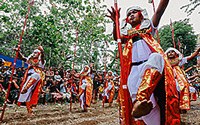
The island has a number of temples dedicated to Jero Gede Macaling and thousands of Balinese visit every year for prayer to please the 'evil' spirits.
Nusa Penida's bottom composition is mainly limestone which drains water and therefore quite barren.
The people live form fishing, seaweed farming and growing corn and cassava on the land.
The cycle of seaweed farming is set by two main aspects.
The first is the ebb and flow of the tide;
seaweed can only be farmed when the tide is low, so if it needs to be cropped and the low tide is at two in the morning, farmers must
work under the light of lamps until dawn.
The second is the duration of the growth cycle, which will vary depending on the type of seaweed.
The fast growing is a brown variant takes 15 days and the slower growing seaweed takes 30 days to harvest.
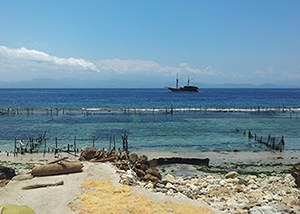
On the north coast are beautiful white sandy beaches, but you can't really swim because of the seaweed farming.
Nusa Penida has old fashioned villages with their own version of weaving, dance and building.
Slowly development is starting on this island, not known to many tourists yet so they prefer to stay on one of the sister islands.
Now you have a couple of home-stays, a hotel, a resort and some restaurants on the island and has a lot to offer.
Rent a bike and take a tour around the island on fairly good roads to enjoy traditional villages and explore the nature of this island.
We can arrange all kinds of accommodation on Nusa Lembongan and now also on Nusa Penida itself!
Dive conditions Nusa Penida
The islands are right in the path of the Indonesian throughflow. Bali and Lombok are divided by The Lombok Strait,
the second most important strait where water is exchanged between the Pacific and the Indian Ocean.
The best times to dive is when the tides peak at slack and high tide, when water movement is the least. See also
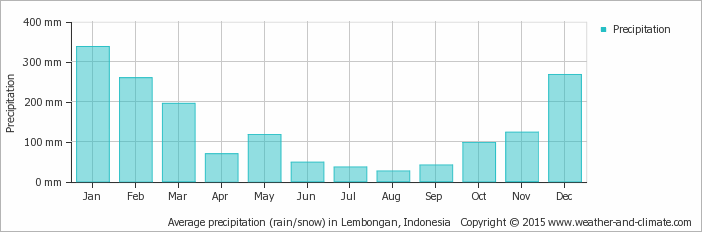
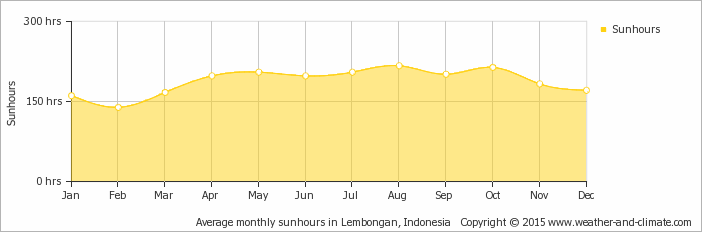
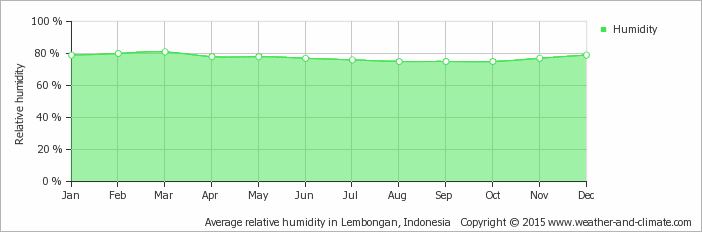
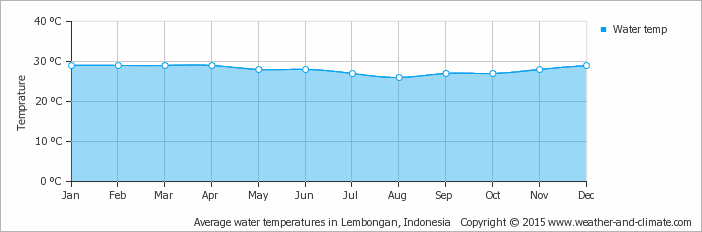
the detailed weather graphs.
Nusa Penida annual weather graphs
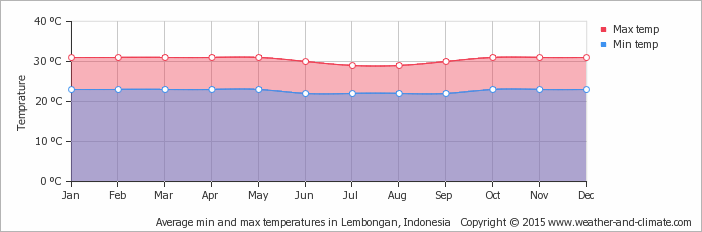
 © 2010-2016 World Weather and Climate Information
Indonesian throughflow
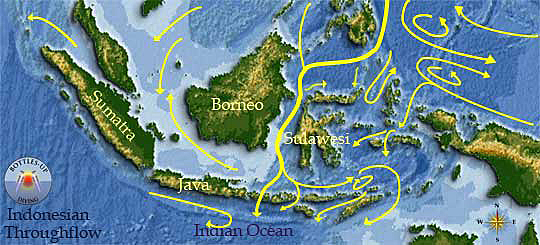
Geologically, Komodo and Rinca are part of Flores lying on a relatively shallow shelf and are separated from Sumbawa by the Sape
Strait where depths are almost 300m. This strait is one of the main channels for the Indonesian Throughflow (as is the Lombok Strait
between Bali and Lombok and the Ombai Strait between Alor and Timor), a water movement that starts in the Philippines, flows past
Sulawesi on the West and East and then hits the barrier of what is Nusa Tenggara (Lombok, Sumbawa, Flores). From here it finds its
way to the Indian Ocean in the South.
The Indonesian Throughflow is strongest during the South East monsoon (June, July, August)
which means, that currents can be really strong here, reaching up to 8 knots (1 knot = 1 nautical mile per hour = 1.852 km per hour)!
During the Southeast monsoons, the tidal flow tends south; during the Northeast monsoons, the tidal flow tends north.
In the area of the strait north of Nusa Penida, the pattern is relatively simple, with a flow, at peak tide, of about three-and-one-half
knots.
Tidal streams in Badung Strait occur every 12 hours and are very unpredictable due to the channel's curved shape and because
the stream runs under an angel towards the general south to north direction of Lombok Strait.
Therefore most dive sites have often very strong and unpredictable currents and undertows which make this more
suitable for experienced divers.
The water temperature can get as low as 20°C due to up welling currents from the depth, this occurs during the months June-October.
Click here for a detailed map of the water depths around the islands.
Sea depths around Nusa Lembongan - Ceningan and Penida
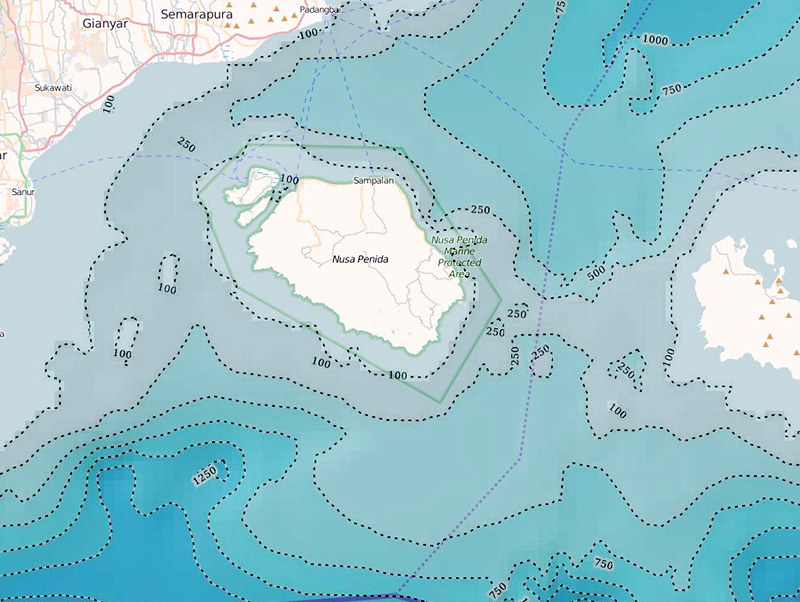 © www.openseamap.org
The north coast of Nusa Penida contains more Coral, because this area is more protected than the south coast which faces the Indian Ocean.
The diving around Nusa Penida is spectacular and here you can see Manta Rays all year round. They can be found at the South coast at Batu Lumbung,
better known as Manta Point, where there are several cleaning stations.
As the Mantas swim close to the cliffs, access is not always easy, especially when the swell is high. Best time to dive here is between
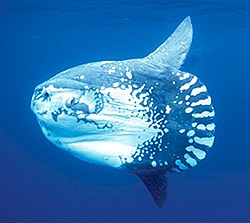
November and May (if the weather conditions allow this), although the Mola-mola / Oceanic Sunfish season
starts from July until October.
Shark numbers are decreasing at a shocking rate.... What all people, especially divers, should know about the shark population.
Shark population
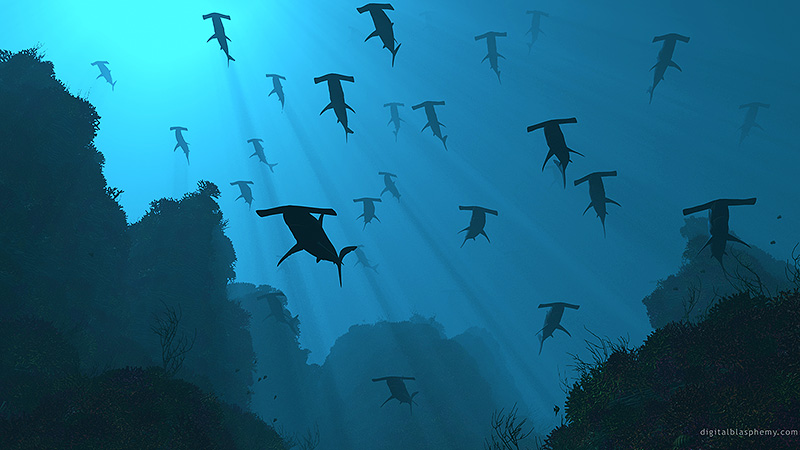
Most divers would love to see sharks, but should realize that there is a great slaughter amongst these apex predators happening every single day.
Indonesia ranks number 1 on the list of top 20 shark catchers.....
Diving in 1995 in the Bunaken national park we encountered sharks every dive. When we went back in 2008 we saw maybe 5 sharks on a total of 60+ dives!
When describing dive sites, we often mention that you might see sharks, but every year the chances are less..
An estimated 100 million sharks a year are killed, mostly for shark fin soup, says a shark researcher of the University of Windsor.
These are the shocking results done by the Institute for Environmental Research published in March 2013 in the journal Marine Policy.
The postdoctoral researcher, Steve Kessel, was part of this research team that came up with a more comprehensive estimate of the number of sharks being killed each year.
Due to the incomplete nature of the data for shark catches, that number could be as low as 63 million or as high as 273 million, but both the high and low end estimates are
considered outside of safe biological limits.
The study also found shark populations cannot reproduce fast enough to overcome that death rate.
There are about 400 species of sharks and 28% of them are threatened by extinction, Kessel said.
“One in every 15 sharks is taken every year”.
The Top 20 shark catchers in descending order are:
Indonesia, India, Spain, Taiwan, Argentina, Mexico, United States of America, Malaysia, Pakistan, Brazil, Japan, France, New Zealand,
Thailand, Portugal, Nigeria, Islamic Republic of Iran, Sri Lanka, Republic of Korea, Yemen.
Sources UNFAO, TRAFFIC 2013
Indonesia and India are responsible for over 20% of global catches between 2002 and 2011. Three EU Member States: Spain, France and Portugal, are among the top 20 shark catchers, responsible for 12% of global catches. Collectively, the 28 EU Member States are the largest shark catching entity of all.
Major hotels that continue to serve shark fin soup include:
Ritz Carlton-Hong Kong
Nikko hotels throughout Asia (headquartered in Japan)
Regal Hotels in Hong Kong
Prince Hotels and Resorts in Japan
InterContinental Group, a UK-based company
This list was comprised in conjunction with Wildlife risk.
Dive sites Nusa Penida
Use the map to jump to the dive site :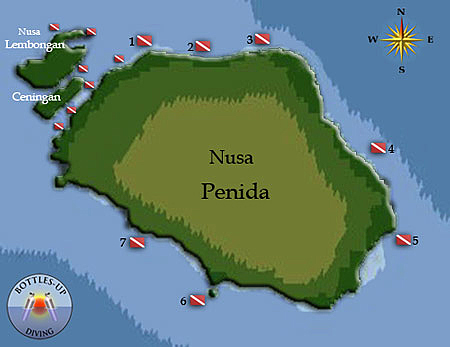
Sekolah dasar [1] / Ped [2] / Sampalan [3]
These 3 dive sites - stretched over a couple of kilometres - located on the north coast of Nusa Penida, have
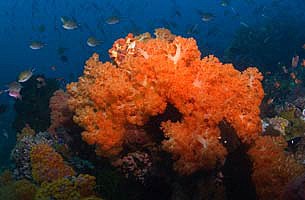
slopes which are covered with Corals and Sponges, especially beautiful Table corals.
The sites slope down to 30 metres, maybe more, and when the current is strong buckle yourself up for a fast drift dive
(when currents are too strong a 'no-no' for beginners).
Visibility is around 20m and more.
These sites are known for sighting of Rays, Tunas, Trevally, Turtles, White and Black-tip reef sharks and if you are lucky, again
the Mola-mola (Oceanic Sunfish). On the way to the dive site (2007) we were accompanied by a small family of 6 Dolphins and this happened
again in 2012 and 2013...so this is not a rare event!
Malibu Point - [4]
This is a small site on the east coast of Nusa Penida and has not always the right conditions to dive due to unreliable currents. This is the place to see the big schools of Jacks, Dog-tooth tuna, Sharks and Mantas.
Batu Abah - [5]
These exposed rocks have beautiful hard Corals and is a combination of walls, white sand, bommies and slopes.
Like Malibu Point this is the site to see the big stuff like Sharks, Tuna, big Barracudas and the Mola-mola. For experienced divers only!
Batu Lumbung [6] / Batu Meling [7]
Better known as Manta Point I and II, are two small bays that are a bit protected, with cleaning stations regularly visited by
Manta rays. The stations are between 4 and 12 metres deep, but the visibility can be poor!
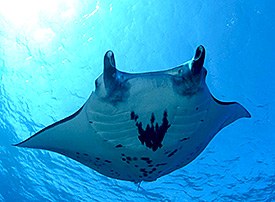 First time we saw Manta rays and this is an experience you will not forget!
During our dive (2005) the visibility was so poor that you saw a Manta just dooming up close in front of you, out of nowhere, totally cool.
We could approach them quite close and looked how they where getting cleaned by the Wrasses.
Due to the swell so close to the rocky shore this was also the first dive one of us got sea sick under water...
This did not stop us to come back many times to dive Manta Point....with great visibility! Since 2005 the number of dive operators
have quadrupled on Nusa Lembongan.
Now (2016) these dive sites have become a major attraction for the dive-operators so unfortunately
it can be a bit crowded underwater.
 |
|