
Coast of Manado - North Sulawesi
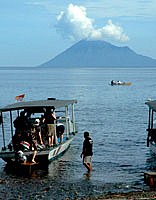
Manado, the capital of North Sulawesi Province of Indonesia, was founded around
the 16th century under the name WENANG, which was changed in Manado in 1623.
The city is located at the Bay of Manado, and was part of the Spice Islands
during colonial times when Sulawesi was known as Celebes.
The Dutch East Indies Company, VOC - Vereenigde Oost-Indische Compagnie in Dutch, used the harbour as main transportation for spices
and built a fortress in 1658.
Read more about the VOCand the Dutch explorations
on the Banda islands page.
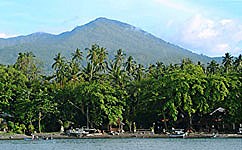
The main religion in this area is Christian, brought in by Portuguese and Dutch missionaries; the result is hundreds of churches, varying from basic to Cathedral-like buildings.
Manado has changed a lot in recent years due to a building boom at the end of the nineties.
The Manado Boulevard, what used to be the city's coastline, is transformed into a strip full of shopping malls which are built on new proclaimed land on the sea side.
Manado is filled with restaurants, shops and bustling markets
Manadonese food is famous throughout Indonesia for two things: the local Minahasa people eat absolutely anything: dogs, snakes, rats, bats, AND is very spicy.
The mountainous area surrounding the city, the Minahasa Highland, is just 25km away from Manado. With its cool climate, easy to climb active volcano's, hot springs, beautiful lakes and scenic markets is worth a visit. There is even a possibility to explore the mountain area on a horse!
In between some hardcore diving it might be an idea to do 1 or 2 day-trips. For animal and nature lovers there is the Tangkoko Nature Reserve near Bitung, about 40km from Manado.
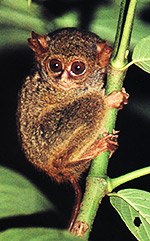
At the reserve you can admire the Tarsier, the world's smallest primate!
Dive conditions Manado
All visitors to the Bunaken National Park , divers and non-divers, are required to pay an entrance fee of Rp 50.000 for a day-pass and Rp 150.000 for a year-pass (January 2017). This money is used to protect and clean-up the park.
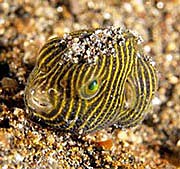
This 12km coast line has many dive sites which are famous for 'muck' diving.
The tidal difference is about 2.2 metres and therefore most dives are drift dives.
Water temperature ranges between 26° and 29°C and the visibility varies between 10-20 metres.
A number of the local resorts around the bay have house reefs with healthy coral and a large variety of marine life.
You can do these dives directly by boat from the resort or make your first dive(s) at Bunaken National Park and do your last dive at one of these sites, everything is possible!
When to visit
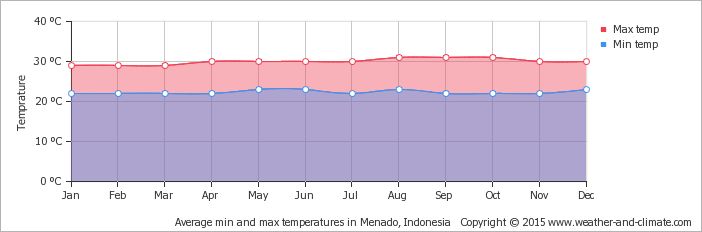
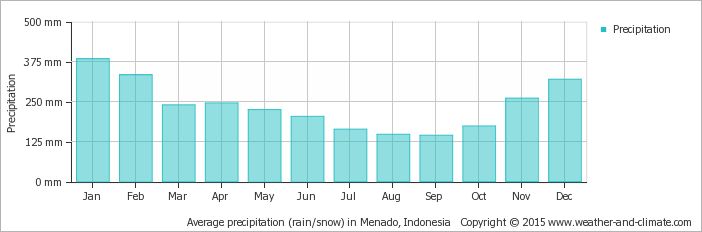
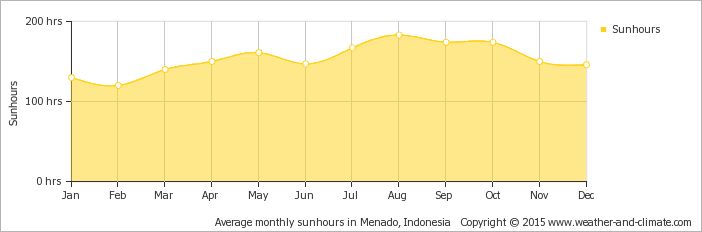
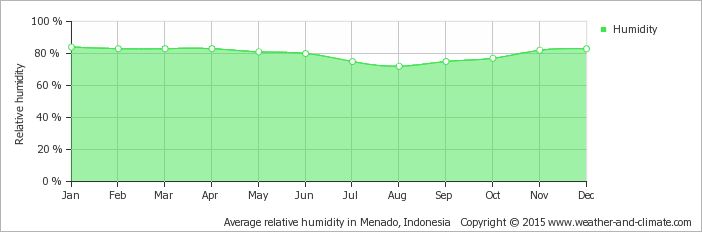
The weather in Manado follows the normal Indonesian dry- and wet season cycle. During the months of December untill March diving is not good because of bad visibility and high waves. See the detailed weather graphs.
Manado annual weather graphs
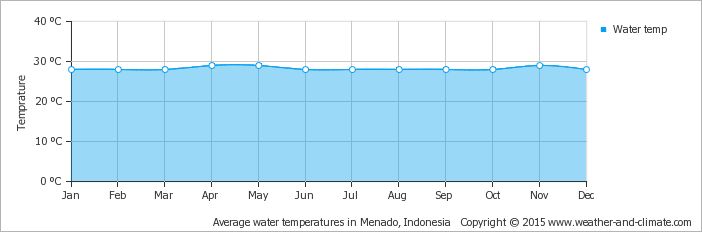 © 2010-2015 World Weather and Climate Information
Shark numbers are decreasing at a shocking rate.... What all people, especially divers, should know about the shark population.
Shark population
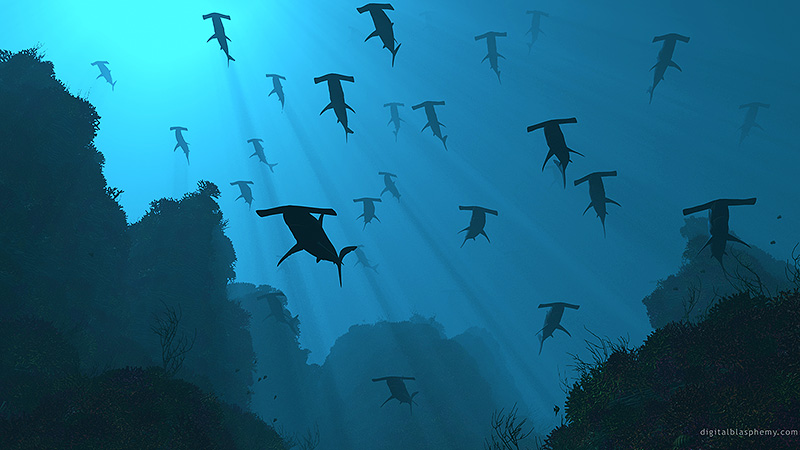
Most divers would love to see sharks, but should realize that there is a great slaughter amongst these apex predators happening every single day.
Indonesia ranks number 1 on the list of top 20 shark catchers.....
Diving in 1995 in the Bunaken national park we encountered sharks every dive. When we went back in 2008 we saw maybe 5 sharks on a total of 60+ dives!
When describing dive sites, we often mention that you might see sharks, but every year the chances are less..
An estimated 100 million sharks a year are killed, mostly for shark fin soup, says a shark researcher of the University of Windsor.
These are the shocking results done by the Institute for Environmental Research published in March 2013 in the journal Marine Policy.
The postdoctoral researcher, Steve Kessel, was part of this research team that came up with a more comprehensive estimate of the number of sharks being killed each year.
Due to the incomplete nature of the data for shark catches, that number could be as low as 63 million or as high as 273 million, but both the high and low end estimates are
considered outside of safe biological limits.
The study also found shark populations cannot reproduce fast enough to overcome that death rate.
There are about 400 species of sharks and 28% of them are threatened by extinction, Kessel said.
“One in every 15 sharks is taken every year”.
The Top 20 shark catchers in descending order are:
Indonesia, India, Spain, Taiwan, Argentina, Mexico, United States of America, Malaysia, Pakistan, Brazil, Japan, France, New Zealand,
Thailand, Portugal, Nigeria, Islamic Republic of Iran, Sri Lanka, Republic of Korea, Yemen.
Sources UNFAO, TRAFFIC 2013
Indonesia and India are responsible for over 20% of global catches between 2002 and 2011. Three EU Member States: Spain, France and Portugal, are among the top 20 shark catchers, responsible for 12% of global catches. Collectively, the 28 EU Member States are the largest shark catching entity of all.
Major hotels that continue to serve shark fin soup include:
Ritz Carlton-Hong Kong
Nikko hotels throughout Asia (headquartered in Japan)
Regal Hotels in Hong Kong
Prince Hotels and Resorts in Japan
InterContinental Group, a UK-based company
This list was comprised in conjunction with Wildlife risk.
Dive sites Manado
Use the map to jump to the dive site :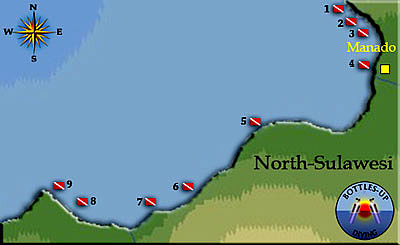
Tanjung Pisok - [1]
This site has a slope that ends in a wall where currents can be unpredictable, because it is on a corner.
In the deeper part you might see Jacks, Bumphead parrotfish and, if you are lucky, a White-tip reef hhark.
In the shallow part you will
find a colourful variation of soft and hard Corals plus a variation of Nudibranchs. Here you are likely to observe Blue-ribbon eels,
Lionfish, Fusiliers, Red-tooth triggerfish and lots of Butterflyfish.
Batu Hitam - [2]
The name of this site means Black Rock and is an excellent macro-site.
Here you find the bottom sloping
from 5-22m and the visibility various between 10-30m.
There are rocky patches with Cuttlefish, Pipefish, Leaf Scorpionfish, Emperor shrimps
and a lot more. Look out for nesting Jawfishes!
Molas wreck - [3]
This German 60m steel-hulled merchant ship sunk on 22 February 1942. It was discovered in 1980 by Loky Herlambang of NDC dive-resort.
The wreck is situated in front of Molas beach that clarifies the name given to it. The wreck is lying
on its side and you will find the bow at 24m and the propellers are at 42 metres deep, which makes it an advanced dive.
The visibility is normally between 5 and 15m. The wreck is covered with soft Coral and you might encounter Giant puffer-fish, White-tip
reef sharks and Napoleon wrasse. On the reef you will find Nudibranchs and sometimes Cuttlefish.
Reclamation area - [4]
This site is in front of Manado just outside of the harbour and is truly a MUCK dive.
Due to construction at the shore the visibility is around 5-10 metres. This site is crowded with Nudibranchs, Shrimps and Crabs, like the
Sponge crab. There are Lionfish and if you pay attention you might find a Ghost-pipefish.
Murex house reef - [5]
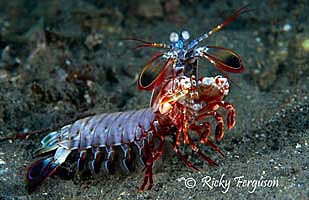
Just in front of this resort you find a sandy bottom which slopes down to 25m and more. Scattered around
are rocky outcrops with Corals and Sponges.
Currents are normally mild, but can be a bit stronger depending on the tide.
Good night diving here with a good chance to see Octopus and a Spanish dancer, but even during the day there is enough to see if you know the site.
Pinnate Batfish, Lionfish, Razorfish, Goatfish, Moorish Idols, Anemones with a variety of tenants like the Anemone crab and different species of Anemonefish all to be found around this site. Look out for the boxing Mantis Shrimp!
Lumba-Lumba house reef - [6]
The dive site is around the jetty and consists of black sand and small Corals. Mandarin fish, Ghost Pipefish, Lobsters and quite a lot of Nudibranchs are found here. The notorious Blue-ringed and Mimic octopus have been spotted on this site.
Critter circus - [7]
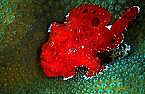
This site has a sandy sloping bottom with Coral blocks and a depth of 25m.
Some artificial reef balls are dropped on the sand and form a nice habitat for juvenile Angelfish, Harlequin ghost-pipefish,
Batfish,
Leaf scorpionfish and other species of Pipefish.
In the shallow part you will find sea grass beds with Sea snakes, Nudibranchs, Crocodilefish and Frogfish.
Popo or Betlehem - [8]
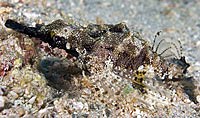
Betlehem is the name given by the dive guides and means, with a bit of imagination, "better then Lembeh",
and they know!
Situated at the foot of the Lokon volcano this site has a black sandy slope with a maximum depth of 30m.
On the bottom you see sand bags with ropes which hold the oyster farm, floating at the surface, in place. Around these bags and ropes are many rare
creatures to be found.
No Corals around here, but sea grass beds and Sponges where you can find amazing creatures like the Pegasusfish, Hairy frogfish, Seahorse and Pipefish. The dive guides are masters at spotting these camouflaged critters.
Popo Malcolm - [9]
More to the of West Betlehem there is a continuing reef with a short wall which is covered in soft Coral and Sponges with a maximum depth of 36m. Here you can find Leaf Scorpionfish, Hawkfish, Crocodilefish and sometimes Napoleon wrasse.

Other locations
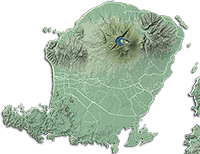
Other dive locations which can be reached easily from Bali or direct from your home country...


 |
|