
Lembeh - North Sulawesi
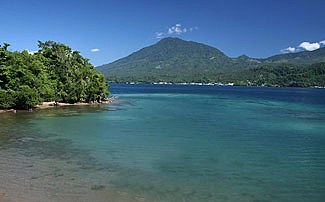
The busy port of Bitung, the main shipping harbour for North Sulawesi, seems an unlikely choice for diving.
Yet just north of the port, in the strait formed by Lembeh island, is some of the most unusual diving anywhere in the world.
Do not expect spectacular walls, huge reefs or white sandy beaches; here it's all about 'muck diving'. Black volcanic sand and rubble is
the domain for a whole array of rare and unusual sea creatures;
at least 7 different species of Seahorse, including the Pygmy seahorse, Mandarin fish, Sea spiders, Stargazers, Harlequin and Skeleton and many more
shrimp species, Pegasus, Hairy frogfish, Mimic octopus, Ghost pipefish and so on...
The last 10 years Lembeh has seen an enormous increase in dive operators and quality accommodation on both the island and the main land.
Diving here can also be done as a day trip from Manado; it's approximately a 1½hour drive from the bay of Manado to Bitung.
The dive boat will be stand-by to take you directly to the dive sites.
Another option for diving the Lembeh strait is a live-aboard cruise, covering the North of Sulawesi and its surrounding islands.
Dive conditions Lembeh
Lembeh island creates a calm channel, protected from both the north-east and south-west monsoon.
Prevailing currents are also concentrated by the strait, bringing a rich supply of plankton, causing the visibility to range around 10-15 metres.
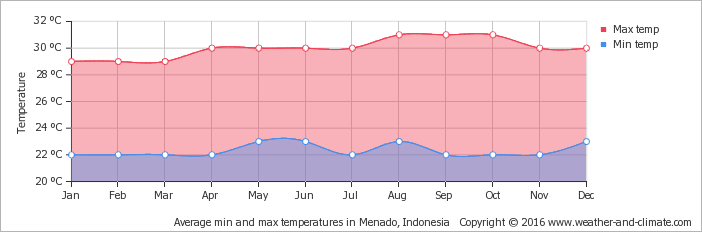
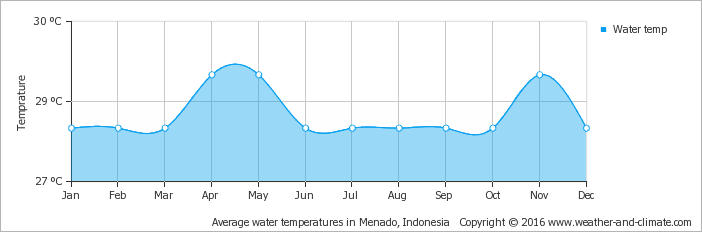
Water temperatures are generally rather cold for the tropics ranging between 26°-27°C.
Almost all of the dive sites are in the depth range of 3-25 metres, so combined with the temperatures: 5mm full suites!
The more you go to the North and out of the bay the dive sites gradually change into more Coral reef and wall diving sites with better
overall visibility.
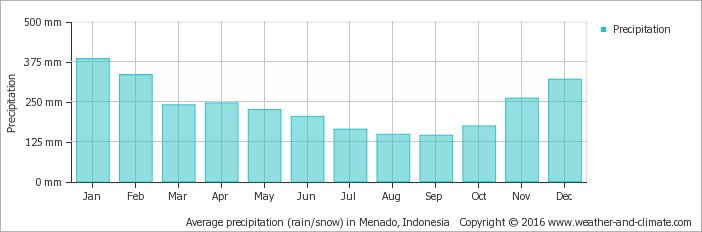
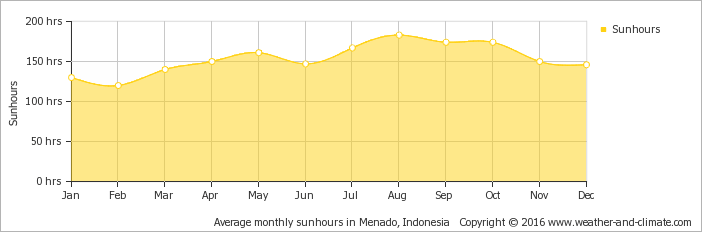
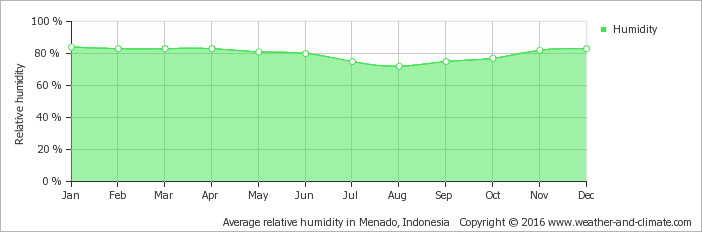
You can dive in Lembeh all year but the conditions do vary. January to June sees variable (but still fine) conditions and less divers.
August sees the poorest visibility but the richest numbers of critters.
September to October are probably the best two months overall.
See also the
detailed weather graphs..
Lembeh annual weather graphs
 © 2010-2016 World Weather and Climate Information
Around the island there are some small but beautiful Coral reefs and at the Northern tip at Batu Kapal, the currents attract large fish like Mackerels and Sharks.
There are also four beautiful covered wrecks, two of them large and all within limits for recreational diving.
Unfortunately, since this area is not a national marine park, the wrecks are still being plundered for metal scrap.
Shark numbers are decreasing at a shocking rate.... What all people, especially divers, should know about the shark population.
Shark population
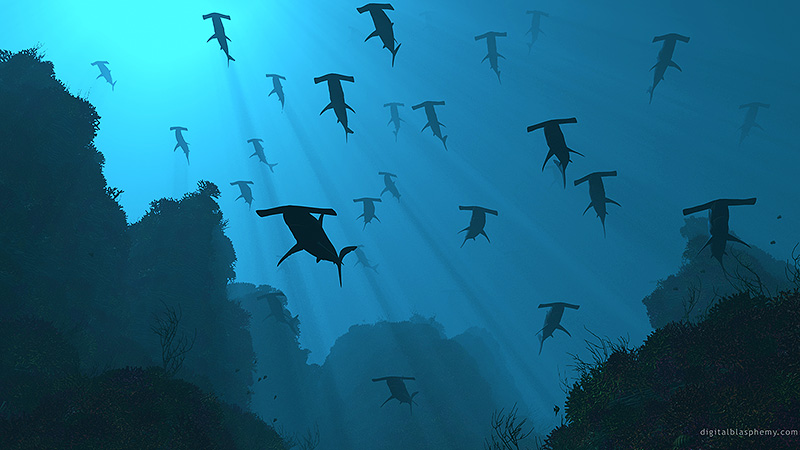
Most divers would love to see sharks, but should realize that there is a great slaughter amongst these apex predators happening every single day.
Indonesia ranks number 1 on the list of top 20 shark catchers.....
Diving in 1995 in the Bunaken national park we encountered sharks every dive. When we went back in 2008 we saw maybe 5 sharks on a total of 60+ dives!
When describing dive sites, we often mention that you might see sharks, but every year the chances are less..
An estimated 100 million sharks a year are killed, mostly for shark fin soup, says a shark researcher of the University of Windsor.
These are the shocking results done by the Institute for Environmental Research published in March 2013 in the journal Marine Policy.
The postdoctoral researcher, Steve Kessel, was part of this research team that came up with a more comprehensive estimate of the number of sharks being killed each year.
Due to the incomplete nature of the data for shark catches, that number could be as low as 63 million or as high as 273 million, but both the high and low end estimates are
considered outside of safe biological limits.
The study also found shark populations cannot reproduce fast enough to overcome that death rate.
There are about 400 species of sharks and 28% of them are threatened by extinction, Kessel said.
“One in every 15 sharks is taken every year”.
The Top 20 shark catchers in descending order are:
Indonesia, India, Spain, Taiwan, Argentina, Mexico, United States of America, Malaysia, Pakistan, Brazil, Japan, France, New Zealand,
Thailand, Portugal, Nigeria, Islamic Republic of Iran, Sri Lanka, Republic of Korea, Yemen.
Sources UNFAO, TRAFFIC 2013
Indonesia and India are responsible for over 20% of global catches between 2002 and 2011. Three EU Member States: Spain, France and Portugal, are among the top 20 shark catchers, responsible for 12% of global catches. Collectively, the 28 EU Member States are the largest shark catching entity of all.
Major hotels that continue to serve shark fin soup include:
Ritz Carlton-Hong Kong
Nikko hotels throughout Asia (headquartered in Japan)
Regal Hotels in Hong Kong
Prince Hotels and Resorts in Japan
InterContinental Group, a UK-based company
This list was comprised in conjunction with Wildlife risk.
Dive sites Lembeh
Use the map to jump to the dive site :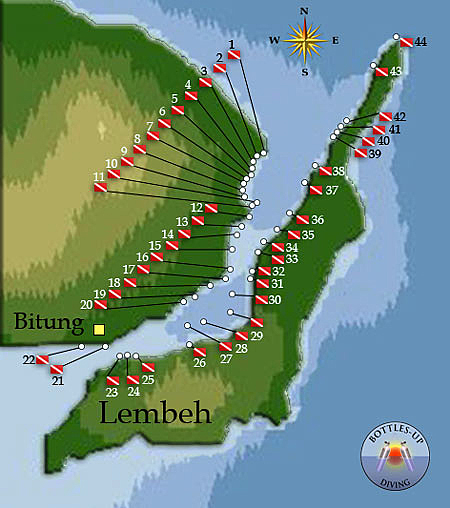
AW Shucks - [1]
Next to a pearl farm, this site has a verdant mix of Coral and sponge growth in the shallows with a
sand slope below along with a large section of weed/rubble.
The shallows offer such finds as Leaf scorpionfish, Cuttlefish and a good Nudibranch selection,
with the sand slope often hosting popular critters such as Hairy frogfish, Flamboyant cuttlefish, Sea horse,
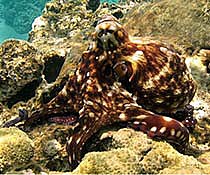
Ghost pipefish, Seamoths (Pegasisae) and Octopus such as the Mimic and Wonderpus species.
Hairball 1 - [2]
This is the most famous of the muck sites and deservedly so. The (only) sand slope here can be exceptionally
productive.
The position on a point means that the mix of currents brings more nutrients than on most other nearby sites.
In the cooler summer season, the shallows can be covered with cotton candy-like Algae, drawing 'hairy' critters such as the Hairy frogfish, Ambon scorpionfish and Filamented ghost-pipefish in.
Other inhabitants such as Cockatoo waspfish and Seahorses can also get 'hairy' as the algae grows on them.
Hairball 2 - [3]
Right around the corner but usually not as rich as Hairball 1, this is very popular as an alternative when Hairball 1
is overcrowded.
This is another sand slope, good for Octopuses, Seahorses and the like. A few Coral bommies in the shallows often harbour Frogfish.
Teluk Kembahu 1 or TK1 - [4]
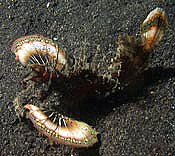
Named after the village in the bay is another gentle black sand slope with a great chance of seeing many
different critters in shallow, easy conditions.
There are low Coral patches below 12 metres and small bommies in the shallows separated by the sand slope. There are usually giant Frogfish in
residence on the Coral patches. Stargazers are often encountered, even in the daytime.
It is a productive octopus-hunting area and is also the best place in the strait to see a variety of Waspfishes and the special
Devilfish in various colour patterns.
Teluk Kembahu 2 or TK2 - [5]
This is a continuation of the same terrain and critters as TK1. Some of the dive sites in Lembeh can be
hot one month and seem empty the next, but on these two sites there is always happy hunting with plenty to see.
This is prime Weedy scorpionfish, Rhinopias frondosa, territory as well, with yellow, brown and purple specimens
in residence for months at a time in recent years.
Teluk Kembahu 3 or TK3 - [6]
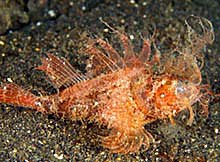
This is a featureless gradual sand slope that is probably the best location in the strait for the
sought-after Mimic octopus as well hosting a wide variety of other Octopus species including the fabled Blue-ringed octopus.
This is also the best site for the rare Ambon scorpionfish, which is the closest relative to the famous Rhinopias.
The area can seem empty, but though there isn't the density of critters of neighbouring sites, it remains a favorite of many.
Retak Larry or Larry's Crack - [7]
Another sand site, but with a small stand of healthy Coral in the shallows. This popular site along with
Hairball 1 and the TK 1/2 area has good variety and number of different species like
Frogfish, Ambon scorpionfish, Cockatoo flounder, Seahorse and the Filamented ghost-pipefish (in season).
It is also the site for explosive breeding Nudibranchs, Gymnodoris ceylonica, as well as various Slug species, not
reported from other sites in the strait.
Slow Poke - [8]
A seldom-dived site between the more popular Retak Larry and Magic Crack, this gentle sand slope has some rubble, which can be productive and a single bommie that at times boasts numerous Ornate ghost-pipefish. For those who move slowly and are observant, Seahorse, Devilfish, Mimic octopus and other gems can be seen here.
Magic Crack - [9]
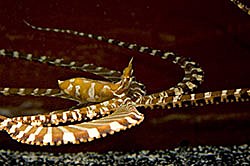
A continuance of the gentle sand slope, the highlight of this dive is a Coral and rubble patch stretching
from 12-27 metres and is the best place in Lembeh to find Thorny seahorse.
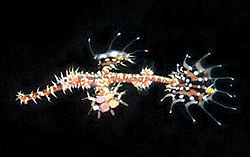
There is a busy cleaning station, a strong Nudibranch representation, Ribbon eels, Ghost pipe-fish and also a good spot for the Wunderpus.
In the shallows towards the bay is sand, but as an alternative for the safety stop there is a healthy hard Coral garden to the side
stretching southward out of the bay.
Magic Rock - [10]
This used to be merely a single bommie with exceptional critter numbers, keeping divers glued on this one rock for an entire dive. Unfortunately Niño caused water temperatures to rise which killed or drove off the life on that Coral head, which never recovered.
Now divers head out over a sand plain, gently sloping to a fantastic wall which goes from 21-50 metres in depth. The sand is usually
not very productive though Waspfishes, Frogfish and Wonderpuses are occasionally encountered. In the shallows there is an exceptional
hard Coral garden from the coast down to 10 metres in depth which offers fine snorkeling.
This site is sheltered from the SE winds (June - Sept.), but subject to swell at times during the rainy season (Nov. - April).
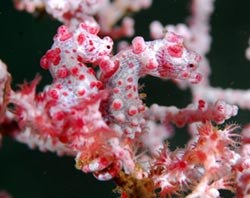
Nudi Retreat - [11]
The most heavily-dived site in the strait, this is a lovely Coral amphitheater in the shallows.
It turns into a sand slope with encrusted boulders down below and two walls stretching out to either side sporting healthy soft Coral growth right up to only 2 metres in depth.
The prime attraction here are Pygmy seahorse, Cockatoo Waspfish and Pegasus seamoths along with the attractive underwater scenery and general variety.
Coral Cat Sharks are often seen here on night dives.
Makawide - [12]
Excellent Coral growth in the shallows spilling down a wall towards the main channel of the strait. On the silty slope below the wall rise a few rocky pinnacles, from 26 up to 15 metres, covered in a rich array of life.
This is an excellent site for Pygmy seahorse and Nudibranchs with very good snorkeling opportunities, though it is subject to strong currents being more exposed than Nudi Retreat.
Jahir - [13]
The most popular muck site along with Hairball 1, this is just another sand and gravel slope with some rope
sponge growth and a few Coral outcrops in the shallows.
Highlights here are Frogfish species, especially the fabled Hairy frogfish -
Antennarius striatus, lots of purple heart Urchins, home to the beautiful Zebra crab, various Cephalopods:
Flamboyant cuttlefish, Wonderpus and Mimic octopus, and a wide variety of venomous fish species.
Excellent for night dives with the opportunity to see the strange Stargazer - Uranoscopidae.
Jari-Jari - [14]
A continuation of the more popular Jahir, this is a wide expanse of shallow sand littered with Sponges
and small bommies.
This site has a steep sand slope leading down to an excellent cleaning station occupying a single large rock down at 26 metres.
Though not as crowded with critters in comparison with Jahir, there are still interesting finds to be had here,
such as Stonefish, various Frogfish and interesting Pipefish.
Air Perang - [15]
The name literally means 'War Water', referring to the jetty offering fresh water from an uphill aquifer,
exploited by the Japanese during WW2.
This is an expansive shallow sand slope, more popular for night diving, especially when strong rising tides limit the possible options
elsewhere in the middle section of the strait.
Good for Octopus species and recently popular for three Rhinopias found in the rubble sections on the northern end of the site,
but the barren terrain and low density of critters mean that it sees far fewer divers compared to the muck sites to its north.
One highlight is the Bobbit worm, commonly seen on night dives.
Nudi Falls - [16]
Together with Nudi Retreat & Hairball, one of the three most-dived sites. A colourful sheer miniwall with a rock pile below, then a sand slope, leveling out into the main channel of rubble sprouting a forest of large soft Corals.
Scenically this site is unlike any other in the strait. There is a whole range of attractions here:
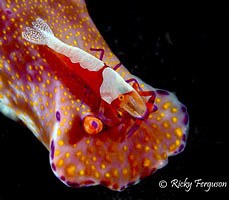
sightings of rare Eschmeyer's Scorpionfish - Rhinopias eschmeyeri, Harlequin shrimp and Boxer crab happen regularly.
Robust ghost pipe-fish, Wonderpuse and other muck critters are found on the sand slope.
Frogfish, Pygmy seahorse, Ornate ghost-pipefish, Batfish, Comet fish, File shells - Ctenoides ales,
and Peacock mantis shrimp are commonly sighted near, in or on the wall along with Nudibranchs.
This is usually the most Nudibranch-rich site in the
strait and along with Jahir, it is the most popular night-diving destination.
Police Pier 1 & 2 - [17]
Like Nudi Falls, photographers keep complaining that the biggest danger on these sites is running out of
film or disk space.
This is a rubble slope with small Coral outcroppings, leveling out into a sand flat with Rope Sponge gardens.
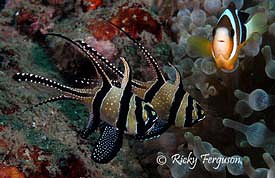
Banggai cardinal fish, Barramundis - Lates calcarifer, Thorny seahorse, Orange frogfish - Antennarius picta,
various Nudibranch species and overall variety are the attractions here.
This is also a truly excellent night dive spot. The scenery isn't pristine; there's plenty of trash in the water, but
it has always been that way owing to the traffic at the Water Police jetty that the site is named after.
Pantai Kecil - [18]
Next to the Police Pier site is a small beach, thus the name. This is a rubble/sand slope with many Coral bommies and is similar to Police Pier in critters found.
Rina Wreck - [19]
An upright fishing boat wreck only just over a decade underwater,
it is not very overgrown yet, but offers
an attractive dive.
The drawbacks are that it is hard to find and being almost mid-channel, is subjected to strong currents.
Napo Bronsel - [20]
A broad seamount forming a shallow plateau just offshore of the village of Tanduk Rusa - Antler deer, this site has damage and garbage owing to being in front of an inhabited stretch of coastline. Still, there is a vibrant cleaning station and some good critter-hunting to be done, with various Octopus, Cuttlefish and Frogfish species being frequently on display.
Bimoli Wreck - [21]
This is a Japanese WW2 wreck lying in front of what is now the Bimoli cooking oil factory.
It was at anchor carrying munitions when it was blown up by torpedoes launched by an attacking US submarine, the USS Swordfish, causing the
munitions to blow the aft end completely apart, which now is a pile of plating on the deep end of the wreck.
The ship lies leaning to one side with the bottom at 32 metres and the highest point on the wreck about 12
metres in depth.
Schools of large Barracuda can be seen at times as well as Potato cod in the hold, White-tip reef sharks dozing beneath and passing Eagle rays. The sponge gardens below the bow and to the starboard side present excellent Nudibranch and other critter possibilities. Visibility here is usually much better than at wrecks further up the strait, though wavy conditions can limit diving here during the height of the June-September SE winds.
Madidir - [22]
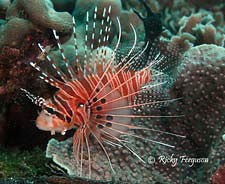
A southern muck site, this is a shallow (2-3m) sand flat leading to a slope down to 20 metres and more, all sand.
A bit different from muck sites within the strait, it is hit-and-miss here, but there can be an exceptional
variety of Fire and Lionfish, Pipefish and lots of juvenile species.
If this is your day you might encounter oddities such as alternative species of Dragonfish, Frogfish and Lionfish
compared to those found on other Lembeh muck sites.
Goby A'Crab - [23]
Another site offering excellent Coral growth in the shallows were you can find Mantis shrimps and
Crab-eyed gobies.
Below is a sand slope with a variety of muck species.
This is a site which always gets glowing reviews from divers.
Kapal Baru - [24]
Recently sunk (the name Kapal Baru means new boat, this is fishing boat caught fire and was towed
away from the harbour into a shallow bay to sink when the flames could not be extinguished.
Lying on its side in less than 15 metres of water, it often offers Ghost pipefish and other interesting finds though it isn't as
fruitful as Kapal Indah, which lies close by.
Kapal Indah - [25]
Kapal Indah, beautiful boat, is an upright fishing boat of about 45 metres long that sits in a shallow,
max. 26 metres, bay out of the main current stream.
The wreck has been down for 40+ years so is covered in Coral life; a great spot for finding Black Coral Crabs on sea Whips and Crinoid critters.
There is an encrusted net hanging over the stern which along with Black Coral bushes around the hull make this a scenic wreck dive.
Critters often seen are Pygmy seahorse, Seagrass arrow shrimp - Tozeuma carolinense, Nudibranchs,
Ornate ghost pipe-fish and Frogfish.
Following time on the wreck, divers can move up a Coral/rubble slope for engaging in critter-hunting
among the bommies surrounding the mooring buoy.
Pulau Abadi - [26]
A Coral slope with many giant sea Fans and an abundance of fish life.
This site has surprisingly good Coral with amazing colours.
It is an excellent spot for locating the beautiful Pygmy seahorse,
Xeno crabs - Xenocarcinus conicus/tuberculatus, Crab-eyed gobies and Mantis shrimps.
Critter Hunt - [27]
There's a rubble slope, some healthy Coral growth and a wall to dive here.
Highlight here are the Banggai cardinal fish and like the name suggests, a wide variety of critters can be spotted:
Pipefish, Eels, Cuttlefish, Crustaceans, Seahorses, Decorator crabs, Devilfish and from time to time the Blue-ringed octopus and Rhinopias make appearances.
Serena west - [28]
Also seldom dived, but there are huge Barrel Sponges hosting Squat Lobster - Laureia siagiani, on this Coral and rubble slope as well as numerous Mandarin fish in the finger Corals in the shallows. There can be a decent variety of critters like Frogfish, Pipefish, Gobies, Crustaceans etc., but the visibility and Coral growth are not as good as on display further up the strait.
Serena North - [29]
There is superb Coral growth in this area, but a lower density of critters on show translates to few divers knowing about this site.
Mawali Wreck - [30]
The most popular wreck in the strait, this huge 70 metres long WW2 Japanese freighter lies on her side
between 17-30 metres depth and offers a Coral-encrusted oasis.
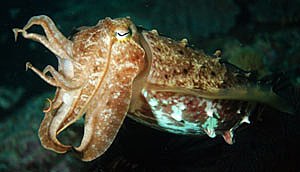
This is an outstanding Nudibranch / Flatworm dive, with huge Scorpionfish and Lionfish guaranteed.
There is a high probability for encountering Cuttlefish, Ghost pipe-fish and Mantis shrimps.
Pintu Kota or Seagrass - [31]
A degraded Coral/rubble slope with much Halimeda algae. It isn't scenic and usually suffers from low
visibility, but this site is good for the seldom-seen Halimeda ghost pipe-fish -Solenostomus halimeda.
It is also notable for other Pipefish species, Nudibranchs and Frogfish.
Pintu Colada - [32]
A ridgeline of healthy Coral that offers decent snorkeling and for divers a busy cleaning station and a variety of critters.
Pantai Parigi - [33]
Something different, this site has a healthy reef in the shallows, then a gentle white sand slope that
is a good alternative to the predominantly black sand elsewhere along the strait.
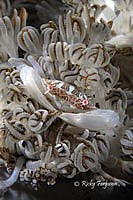
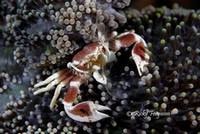
A superlative location for small Crustaceans, especially Commensal species.
Commensalism is a class of relationship between two organisms where one benefits and the other is not significantly harmed or benefited.
This slope also has a variety of Cephalopods, Frogfish, Gobys, Mantis shrimps, Seahorses, Devil fish and Robust pipefish.
Tanjung Kubur - [34]
A newer site also known as Cemetery Point, this is another sand slope with large healthy bommies to the South and excellent Coral gardens to the North. There have been Rhinopias, Pontohi pygmy seahorse and Halimeda ghost pipe-fish seen here.
Tanjung Tebal - [35]
This stunning area offers huge boulders, creating canyons and shelves which stretch well out into the
strait down past 50 metres in depth.
Strong currents are usually found here, demanding dive planning at slack tide.
The currents result in bigger schooling fish like Jacks, Trevally, Rainbow runners and Mackerels.
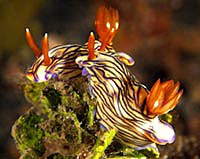
Countless large sea Fans in a variety of hues, an abundance of encrusting invertebrates and various critters like the current-loving spectacular Nudibranch specie Nembrotha purpureolineata, making this an extraordinary dive if timed correctly.
Batu Sandar - [36]
Or leaning rock in Malay is one of the very best snorkeling sites in the strait. This is a finger of Coral which
extends out into the strait down to 20 metres on a sand slope.
Sheltered shallows have superlative Coral and sponge growth and sand flats with large Coral bommies.
Angel's Window - [37]
The most popular of the Lembeh island sites, this is a twin-peaked pinnacle that comes within a meter of the surface. A large cave offers a swim-through for divers on the deep end of the pinnacle, from 24 metres down to 32 metres in depth.
One side is a Coral slope leveling out onto a sand flat at 15 metres.
On the other side is a wall to a shelf at 8 metres, then a small plateau and another drop-off, down to 20-32 metres.
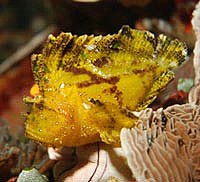
Schooling fish, numerous Pygmy seahorse, including the new, unofficially-named Hippocampus pontohi, Leaf scorpionfish, Reef octopus, Cuttlefish, Nudibranchs and much more.
Batu Merah - [38]
Or red rock in Malay is a site that offers two dives: a rich Coral slope or a steep sand slope with Coral bommies. A cleaning station at 24 metres is a focal point, but there is a wide array of Nudibranch, Pipefish, Crustacean and Cephalopod species.
Pulau Putus - [39]
Inside a bay is a beautiful Coral and sponge garden in sheltered conditions. The scenery itself is the highlight, though larger Rays, like Devil and Eagle rays, are seen from time to time, together with the shy Jawfish on a sand slope by the mooring.
California Dreaming - [40]
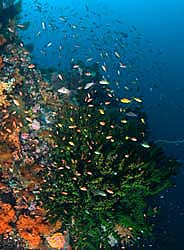
This seamount, out from the island of Pulau Putus is a stunning site.
Twin peaks with a rubble/sand flat in between, the shallows are good for giant Frogfish and Boxer crabs and there is a busy cleaning station which offers much to see, including Leaf scorpionfish.
The Coral slopes down on both sides, but the most exposed section is a series of steps formed by boulders and sand shelves.
They descend into the depths, covered with an amazing variety of Gorgonians, sea fans and brilliant orange tree Corals that bloom when the current is running.
Passing Mackerel and Tuna are the larger fare and Turtles are often encountered, though at this site the scenery overwhelms the occupants.
Kainah's Treasure - [41]
This is a rocky, Coral slope; one of the best places for Nudibranchs in the strait!
Jiko Yansi - [42]
A scenic wall dive, filled with beautiful soft Corals, sea Fans and Sponges. This is a good spot for Pygmy seahorse, Candy crabs and other small finds.
Dante's Wall - [43]
Starting on a sand/Coral slope, a massive sheer rock wall starts and as you drift along it the bottom
gets deeper and deeper as you near the Northern tip of Lembeh Island.
There are schooling reef fish and interesting finds to be discovered along this spectacular drop.
Batu Kapal - [44]
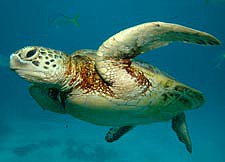
These are a set of pinnacles off the northern tip of Lembeh Island.
This is the best big fish dive in North Sulawesi, but severe multi-directional currents prevent all but only the most experienced divers
from venturing here. The density of schooling fish is staggering, with larger species such as Dogtooth tuna, Barracuda, Big-eyed jacks,
Giant trevally and Rainbow runner well represented.
Turtles, White-tip and Grey reef sharks as well as Eagle rays are also common. Even Silver-tip and
Whale sharks have been spotted here by the lucky few.
Batu Angus - [45]
Is the site of an old lava flow, hence the name, which literally means burnt rock.
This shallow site of around 10 metres deep and about 50 metres across is visited at sunset to see the colourful Mandarin fish mating!
There are regular sightings of the Blue ringed Octopus at this beautiful tranquil dive site which is also a good spot for snorkeling.
Other locations
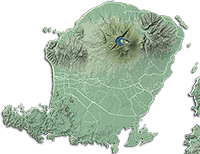
Other dive locations which can be reached easily from Bali or direct from your home country...



 |
|